Key Takeaways
You do not need an agent to sell land, and skipping one keeps thousands of dollars in your pocket if you choose the right platform.
- Land commissions commonly run 5 to 10 percent, often near the top on lower-priced parcels, so selling by owner can save you $4,000 or more on a $40,000 lot.
- The best results come from platforms with a land-focused buyer audience, not general real-estate sites where lots get buried under houses.
- Each of the 5 platforms below wins for a different seller: accurate pricing and reach, sheer traffic, free local exposure, cheap listings, or fast cash.
- Selling without a realtor means you handle pricing, marketing, and coordinating a title company, but the process on vacant land is far simpler than selling a house.
- Match the platform to your goal: top price and serious buyers, or speed and certainty. Trying to do both at once is where sellers lose momentum.
Selling vacant land is one of the easiest real-estate transactions to handle on your own, yet many owners still hand over a large commission out of habit. If you want to sell vacant land without a realtor, the deciding factor is not whether you can, it is which platform actually puts your parcel in front of ready buyers.
This guide skips the generic advice and names 5 platforms that get results, what each one is best for, and the honest tradeoffs, so you can pick the one that fits your goal and keep the commission for yourself.
Quick verdict: If you want the best price and serious buyers, list on a land-focused marketplace with pricing tools. If you want speed over top dollar, sell to a direct land buyer.
Facebook Marketplace and Craigslist work for cheap local exposure but attract more tire-kickers. The right choice depends on whether your priority is price or speed, not on any single site being best for everyone.
How much do you save selling land without a realtor?
You typically save 5 to 10 percent of the sale price by selling land without a realtor, which is often more than sellers expect. Land commissions frequently sit at the higher end of that range because agents earn less per deal on lower-priced parcels, so many charge close to 10 percent or a flat fee that works out even higher on cheap lots.
The math is simple and motivating. On a $40,000 parcel, a 10 percent commission is $4,000. On a $100,000 lot at 8 percent, you keep $8,000.
Even after the 2024 changes to how the National Association of Realtors handles commissions, agent fees remain largely negotiable rather than lower in practice, so the savings from going by owner are still real.
That saved commission is money you can use to price competitively, invest in better listing photos, or simply pocket at closing.
Can you really sell vacant land without an agent?
Yes, you can sell vacant land without an agent, and land is one of the simplest property types to sell yourself. Unlike a house, there is no staging, no repairs, no showings around a family’s schedule, and far less that can go wrong in an inspection.
Your main jobs are pricing it right, marketing it where land buyers look, and letting a title company or attorney handle the closing paperwork.
What you take on is straightforward: setting a fair price from comparable sales, writing an honest listing, answering buyer questions, and coordinating the closing. None of it requires a license.
If you want the full step-by-step process, our complete guide to selling land by owner walks through pricing, paperwork, and closing in detail. This article focuses on the piece most guides gloss over: exactly where to list so the effort actually produces a sale.
What makes a land platform actually get results?
A platform gets results when it puts your parcel in front of people who specifically want to buy land, not just anyone browsing real estate. That is the single biggest factor most sellers overlook.
A lot buried among thousands of houses on a general real-estate site gets fewer serious looks than the same lot on a site where every visitor is there for land.
Judge any platform on four things: the intent of its audience, how much it costs you to list, how fast it tends to produce inquiries, and whether it gives you tools like accurate pricing and direct buyer messaging.
The five platforms below each score differently on those four, which is why the best pick depends on your situation. You can compare active demand yourself by browsing current land listings to see how comparable parcels are priced and how quickly they move.
Platform 1: RawLandHub, best for pricing right and reaching land buyers commission-free
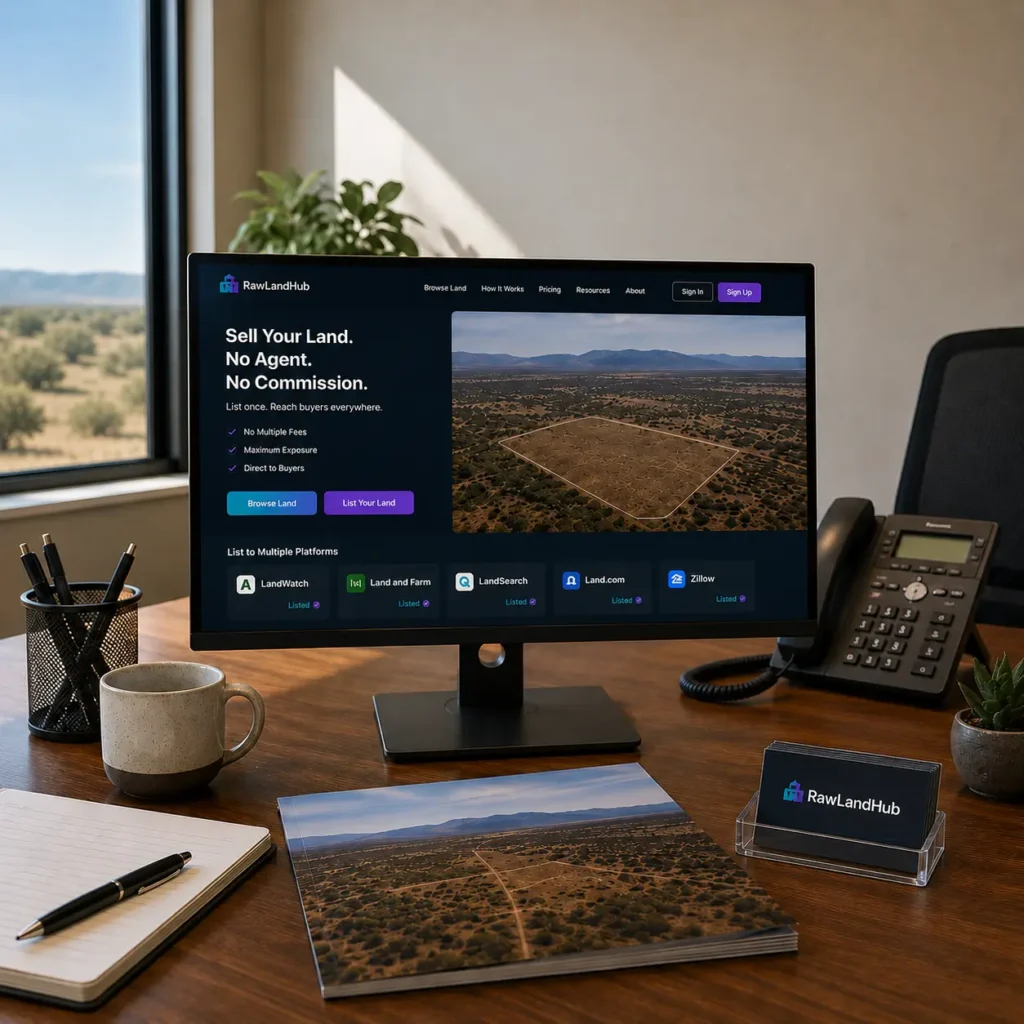
RawLandHub is best for sellers who want accurate pricing and a land-only buyer audience without paying any commission. It is an AI land marketplace built specifically for vacant land, so every visitor is there to buy or research land, not houses.
The AI pricing tool gives you a data-backed value in seconds, which solves the number-one reason land listings stall: a price that is guessed rather than grounded.
The honest tradeoff is that a land-specialist marketplace is more focused than the giant general networks, so you are reaching a qualified land audience rather than the entire internet.
For most sellers that is an advantage, because qualified beats large when you are selling a niche asset. Plans are flat monthly fees with zero commission taken from your sale, so what you agree to with the buyer is what you keep.
You can create a free listing and get an AI price estimate before you commit to anything.
Platform 2: Large legacy land networks, best for maximum reach
The big established land-listing networks, including sites like LandWatch, Land.com, and Lands of America, are best for sellers who want the widest possible exposure and do not mind paying for it.
These networks have been around for years, rank well in search, and pull in a large volume of land shoppers, which is their genuine strength.
The tradeoffs are real, though. Many of these platforms charge per-listing fees that add up, and they are built around agents, so by-owner sellers can feel like second-class citizens and buyers often still expect an agent in the loop.
Your listing also competes against thousands of others, which can bury a modest parcel. Use these networks when raw reach matters most and the listing cost fits your budget.
If per-listing fees are your concern, a flat monthly plan usually works out cheaper for anyone listing more than one parcel or keeping a listing up for several months.
Platform 3: Facebook Marketplace, best for free local exposure
Facebook Marketplace is best for sellers targeting local and regional buyers who want free exposure and are comfortable filtering casual inquiries.
Posting is free, the audience is enormous, and local land groups can connect you directly with nearby buyers, neighbors, and hunters or farmers who want the parcel next door. For rural and recreational land, that local network effect genuinely produces sales.
The catch is buyer quality. Facebook attracts a lot of casual browsers, lowball offers, and the occasional scam, and it gives you no land-specific pricing or vetting tools. You will field more messages to find a serious buyer.
Treat it as a free supplement to a dedicated land platform rather than your only channel, and never share sensitive details or accept payment methods you cannot verify. Used alongside a land marketplace, it widens your net at no cost.
Platform 4: Craigslist, best for cheap, simple local listings
Craigslist is best for sellers who want a dirt-cheap, no-frills local listing and are willing to manage a rougher experience.
Listings are nearly free, the format is simple, and in many regions Craigslist still has an active real-estate section where local buyers look for lots and acreage. For a low-value parcel where you do not want to spend anything, it can work.
Be realistic about the downsides. Buyer intent is lower than on a dedicated land platform, the interface is dated, and scams are common, so you must screen carefully and never wire money or share bank details.
There are no pricing tools, no buyer profiles, and limited reach beyond your metro. Craigslist is a fine free add-on for local visibility, but on its own it rarely delivers the price or the serious buyers a land-focused marketplace does.
Platform 5: Direct land buyers, best for speed and certainty
Selling to a direct land buyer is best when speed and a guaranteed sale matter more than getting top dollar. These are companies and investors who buy vacant land for cash, often closing in a couple of weeks with no financing contingencies.
If you inherited a parcel you do not want, owe back taxes, or simply need to be done, this path removes the wait entirely.
The clear tradeoff is price. Direct buyers offer below market, commonly well under retail, because they take on the risk and resale effort. You trade money for certainty and speed.
This route is not a platform you list on so much as a buyer you contact, and it is worth getting more than one offer so you know the range.
To avoid leaving money on the table, always collect at least two or three offers and compare them against a real estimate of your parcel’s market value before you accept.
Which platform gets results for your situation?
The right platform depends on whether your priority is price, reach, cost, or speed. Use this quick guide to match your goal to the best starting point, and you can get in touch with our team if you want help choosing. Remember that combining a dedicated land marketplace with a free local channel often works better than relying on any single site.
| Your priority | Best platform | What to expect |
| Best price plus accurate pricing | Land-focused marketplace | Serious land buyers, AI value, no commission |
| Maximum raw reach | Large legacy land networks | High traffic, per-listing fees, agent-oriented |
| Free local exposure | Facebook Marketplace | Big local audience, more casual inquiries |
| Cheapest possible listing | Craigslist | Low cost, low intent, screen carefully |
| Speed and a sure sale | Direct land buyers | Fast cash close, below-market price |
Most sellers who want both a strong price and a real audience start with a land marketplace and add Facebook for local reach.
To see how affordable that primary listing is, the monthly plans start at a few dollars with no commission, far below the cost to sell land through an agent at 10 percent.
Mistakes that kill your results when you skip the realtor
The biggest mistakes are overpricing, listing in the wrong place, and thin listings, and all three are avoidable. Overpricing is the number-one reason by-owner land sits unsold, because without an agent nobody is there to talk you off an emotional number.
Price from real comparable sales, not hope. Listing only on a general real-estate site buries your parcel among houses where land buyers rarely look.
Thin listings are the third killer. Land buyers want specifics: acreage, access, utilities, zoning, GPS coordinates, and clear photos or a simple map. A listing that just says “5 acres for sale” gets ignored.
Fill in every detail, add multiple photos, and be honest about limitations, since serious buyers reward transparency and disappear at the first sign of vagueness. Get the price, the platform, and the listing quality right, and selling without a realtor becomes not just possible but clearly the better deal. When you are ready, you can list your parcel and reach land buyers directly in minutes.
Frequently asked questions
Is it legal to sell vacant land without a realtor?
Yes, it is completely legal to sell your own vacant land without a realtor in every state. You are not required to use a licensed agent to sell property you own. You will still want a title company or real estate attorney to handle the closing and transfer the deed correctly, but that is a closing service, not a sales agent, and it costs far less than a commission.
What is the best site to sell land without an agent?
The best site is a land-focused marketplace, because every visitor is there to buy land rather than browse houses. A platform with accurate pricing tools and no commission gives most sellers the strongest combination of serious buyers and money kept. Pair it with a free local channel like Facebook Marketplace to widen your reach at no extra cost.
How much commission do you save selling land by owner?
You typically save 5 to 10 percent of the sale price, and often closer to 10 percent on lower-priced parcels where agents charge more. On a $50,000 lot that is $2,500 to $5,000 kept in your pocket. Land commissions tend to run higher than home commissions because the agent earns less per transaction, which makes selling by owner especially worthwhile on land.
How long does it take to sell land without a realtor?
It varies widely by price, location, and platform, from a couple of weeks with a direct cash buyer to several months on the open market. Accurately priced land in a desirable area listed on a land-focused site tends to move fastest. Overpriced parcels or those listed only on general sites can sit far longer, which is why platform choice and pricing matter so much.
Do I need a lawyer to sell land without an agent?
Not always, but it is wise. Some states use title companies to close land sales, while others expect a real estate attorney to prepare the deed and handle the transfer. Either way, a closing professional protects both sides and ensures the title transfers cleanly. This is a modest, flat cost and is not the same as paying a sales commission.
Resources and Further Reading
- Review how a real estate broker is compensated to understand how commissions and agents traditionally work.
- This overview of the multiple listing service explains why property sales have historically favoured agent-led transactions.
- The guide to for sale by owner explains the trade-offs of selling property without an agent.
- The National Association of Realtors research and housing statistics tracks current sales trends, market activity, and pricing.
- This plain-English guide to the for sale by owner process explains the key steps to consider before choosing where to list your parcel.