Key Takeaways
A cost breakdown of the three ways to sell vacant land, what each really charges, and which one keeps the most money in your pocket.
- An agent is the most expensive route, with land commissions often running 6% to 10%, higher than the 5% to 6% typical on homes.
- FSBO saves the commission but shifts all the marketing, paperwork, and buyer exposure onto you.
- A flat-fee platform charges a fixed subscription with zero commission, so your cost does not grow with your sale price.
- Some closing costs, such as title and transfer taxes, are the same no matter how you sell.
- On a $50,000 parcel, the selling-method cost ranges from about $4,000 with an agent down to roughly $45 on a platform.
Figuring out how much it costs to sell land is really a question about one number: how big a cut the selling method takes. An agent’s commission scales with your price, FSBO trades money for your own time, and a flat-fee platform charges the same whether your parcel sells for $10,000 or $250,000.
This comparison lays out all three side by side, with real dollar examples, the honest trade-offs, and the costs that stay fixed no matter which path you choose.
Quick verdict: Agents cost the most and make sense for complex or high-value parcels you have no time to market. FSBO saves the commission but puts all the work and buyer exposure on you.
A flat-fee platform costs the least and fits most land sellers who want reach without giving up a percentage of the sale.
What Does It Actually Cost to Sell Land?
The cost of selling land breaks into two parts: the selling-method cost, which is the big variable, and the closing costs, which stay roughly the same across all three methods. The selling-method cost is where agent, FSBO, and platform differ by thousands of dollars.
Here is how the three compare on a sample $50,000 parcel. Before you decide, it helps to check what similar parcels are asking, so you can compare active land listings and price yours correctly.
| Selling method | Typical cost to sell | On a $50,000 parcel | How it scales |
| Real estate agent | 6% to 10% commission | About $3,000 to $5,000 | Grows with sale price |
| FSBO (for sale by owner) | Flat-fee listing plus marketing | About $500, up to $2,000 if you offer a buyer-agent commission | Mostly fixed plus your time |
| Platform (flat subscription) | Monthly fee, zero commission | About $45 | Fixed, does not scale |
The gap is stark because commission is a percentage while a platform fee is a flat dollar amount. On top of the selling-method cost, every seller also pays closing costs like title and transfer taxes, covered further down. Those are unavoidable, so the smart move is controlling the one cost you can actually change.
How Much Do You Pay Selling Land Through an Agent?
Selling land through an agent typically costs 6% to 10% of the sale price in commission, which is higher than the 5% to 6% most homes pay because land is harder and slower to sell. On a $50,000 parcel at 8%, that is $4,000 gone before you count any other cost.
Commissions are fully negotiable, and they became more openly so after the NAR settlement that took effect on August 17, 2024. Under the new rules, buyer-agent compensation offers are no longer posted on the MLS, and every buyer must sign an agreement stating in plain language that commissions are not set by law. For sellers, that means the old assumption of a fixed total commission is gone, and you can and should negotiate the listing fee.
The trade-off is real service. A good land agent, working as a licensed real estate broker, handles pricing, marketing, showings, and negotiation. On a complicated or high-value parcel, that can be worth the cut. On a straightforward rural lot, paying 8% to 10% often buys less value than sellers expect, because raw land needs less hand-holding than a house and far fewer showings.
What Does FSBO (For Sale by Owner) Cost?
FSBO costs far less in fees than an agent, usually a few hundred dollars for a flat-fee MLS listing, signage, and photos, but it costs you time and reach. You skip the listing commission entirely, though you may still choose to offer a buyer-agent commission of around 3% to attract agent-represented buyers.
Here is the honest picture on the numbers. For sale by owner sales have fallen to about 5% of all home sales, an all-time low, according to NAR’s 2025 Profile of Home Buyers and Sellers. That same report shows FSBO properties sold at a lower median price than agent-assisted ones, though NAR notes this is partly because FSBOs skew toward lower-cost rural land and mobile homes, not proof that going it alone always nets less.
FSBO fits sellers who are comfortable with paperwork and pricing, especially those who already have a buyer lined up. The cost you cannot see on an invoice is exposure. A yard sign and a single listing reach a fraction of the buyers an active marketplace does, so a cheap FSBO can quietly cost you weeks or months of carrying the land.
What Does It Cost to Sell Land on a Platform Like RawLandHub?
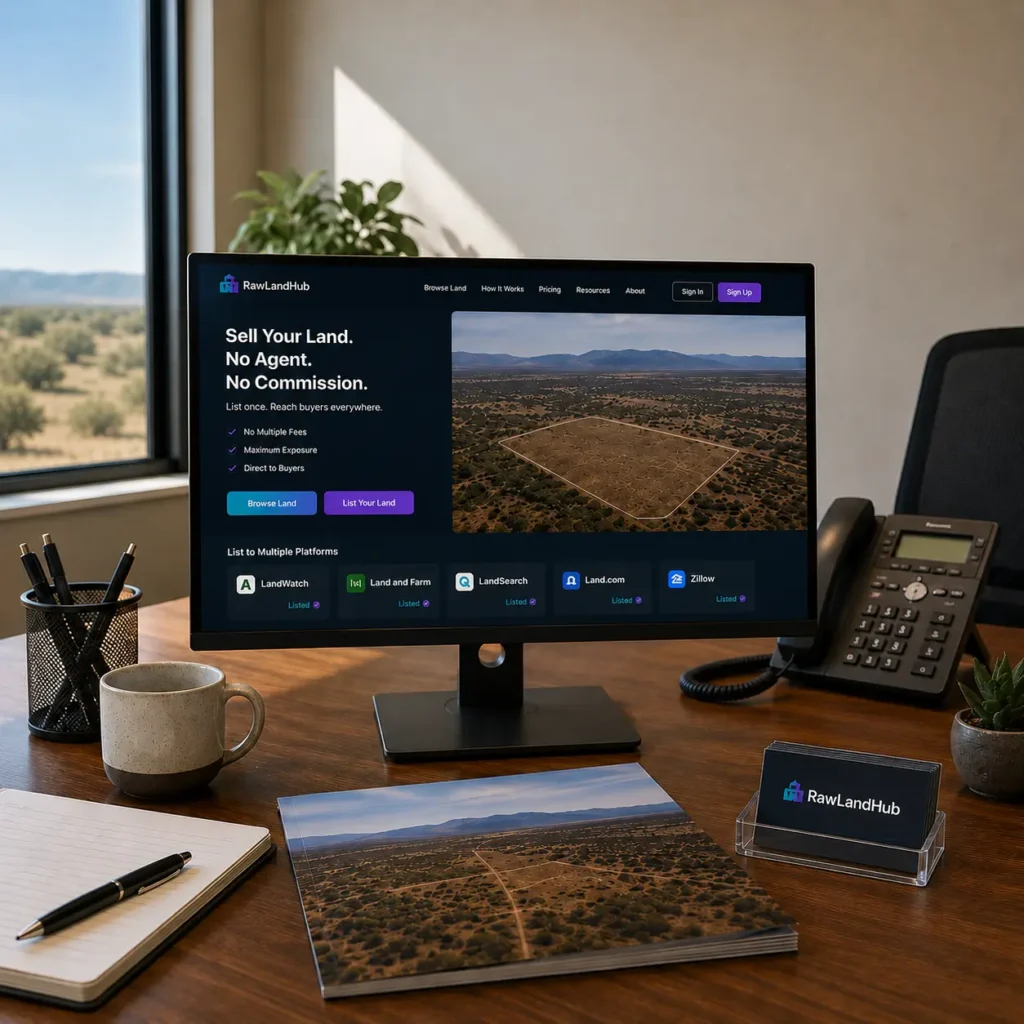
A land-selling platform charges a flat subscription and takes zero commission, so the cost is fixed no matter what your parcel sells for. RawLandHub uses monthly plans of $5, $15, and $30, with a seven-day free trial and no card required, and it never takes a percentage of your sale.
Run the math and the difference is obvious. If your parcel sells in about three months on the $15 plan, your total selling-method cost is roughly $45. Compare that to $4,000 in agent commission on the same $50,000 sale, and the platform keeps about $3,955 in your pocket. Because the fee is flat, the savings only grow as the sale price climbs. On a $250,000 parcel, a 8% commission is $20,000, while the platform still costs about $45.
The trade-off versus an agent is that you handle your own listing and buyer conversations, though a good platform makes that far easier than raw FSBO. You can start a free trial and test the listing tools before paying anything. This route fits the large middle of land sellers who want real buyer reach without surrendering a percentage of the price.
Agent vs. FSBO vs. Platform: Where Each One Wins
No single method is best for everyone, so here is the honest concession on where each option genuinely earns its cost. An agent wins when the parcel is complex, high-value, or in a market you do not understand, and when you have zero time to manage the sale. Paying a commission to offload the entire process can be worth it.
FSBO wins when you already have a buyer, such as a neighbor or a family member, and just need the paperwork done cheaply. In that case, paying any commission or subscription is wasted money. FSBO also suits experienced sellers who have moved land before and know how to price and market it.
A platform wins for the majority in the middle: sellers who want an agent’s reach without an agent’s percentage. For land owners who choose to list their land themselves but still want serious exposure, a flat fee with zero commission is usually the cheapest path to a fair-market sale. The main group who should avoid the platform-or-FSBO route is anyone unwilling to answer buyer questions or handle a simple closing, since both require light involvement.
One cost rarely shows up in these comparisons: your time and the carrying cost of the land while it sits. Property taxes, and any loan payment, keep running every month the parcel is unsold. A method that saves 8% in commission but leaves the land on the market for six extra months can quietly erase those savings in taxes and interest. That is why buyer reach matters as much as the fee. The cheapest sale is the one that actually closes at a fair price, and closes reasonably fast.
Which Selling Method Is Cheapest for Your Land?
The cheapest method for your land depends on your price, your timeline, and how much work you want to do. If you are unsure which fits your parcel, you can get in touch with our team. For most vacant land under a few hundred thousand dollars, a flat-fee platform is the lowest-cost way to reach real buyers, because the fee never scales with your sale price.
Match your situation to the right route:
- Straightforward rural or recreational lot, want reach without commission: a flat-fee platform is cheapest.
- Already have a buyer, just need paperwork: FSBO with a real estate attorney is cheapest.
- Complex, high-value, or you have no time to manage it: an agent may justify the commission.
RawLandHub keeps the entry cost low with monthly plans starting at $5, and you can get started free with a seven-day trial before committing. Whatever you choose, decide based on the total money that reaches your bank account, not the sticker price of the service.
What Costs Stay the Same No Matter How You Sell?
Some costs do not change based on your selling method, so do not let any platform or agent claim to eliminate them. These are the standard closing costs that apply to essentially every land sale.
Expect to pay some mix of these regardless of route: title services and title insurance, which the seller often covers, plus recording fees, a possible survey, prorated property taxes, and attorney or escrow fees where applicable. On top of those, most sales include a real estate transfer tax, an excise charged by the state, county, or city when ownership changes hands, and the seller commonly pays it. Rates vary widely by location.
The key point: these fixed costs are the same whether you use an agent, sell FSBO, or list on a platform. So when you compare methods, compare only the part you control, which is the selling-method cost. Consult a local real estate attorney or title company for your exact closing figures, since this is general information, not legal or tax advice.
Common Mistakes That Cost Land Sellers Money
The most expensive mistake is defaulting to a full-commission agent without negotiating or comparing cheaper routes, simply because that is how home sales usually work. Land is not a house, and the sale often needs far less agent labor than the commission implies.
Watch for these money-losing traps. Accepting the first commission quote without negotiating, now that fees are openly negotiable, leaves thousands on the table. Mispricing the parcel, whether too high to sell or too low out of impatience, costs more than any commission. Choosing FSBO purely to save money, then getting almost no buyer exposure, can cost you months of property taxes while the land sits. And forgetting that closing costs like title and transfer taxes apply to every method leads to nasty surprises at the table. The fix for all of them is simple: compare the total cost to sell, not just the headline fee.
One more overlooked cost is preparation. A parcel with a clear access description, a recent survey, and clean photos tends to sell faster and closer to the asking price, which lowers your true cost of selling on any route. Spending a little upfront to present the land well usually pays for itself in a quicker, stronger sale, whichever method you pick.
Frequently Asked Questions
What percentage do agents take to sell land?
Land commissions typically run 6% to 10% of the sale price, higher than the 5% to 6% common on homes, because land takes longer to sell and needs more marketing. Since the 2024 NAR settlement, commissions are openly negotiable, so you can and should negotiate the rate before signing a listing agreement.
Is it cheaper to sell land without a realtor?
Usually yes, on fees. Selling FSBO or on a flat-fee platform avoids the agent commission, which is the single largest selling cost. The trade-off is that you handle marketing and buyer questions yourself. For many land sellers, a platform with zero commission delivers most of an agent’s reach at a fraction of the cost.
How much does it cost to sell land on a platform?
Flat-fee land platforms charge a subscription rather than a commission. RawLandHub uses monthly plans of $5, $15, and $30 with a free trial, and takes no percentage of your sale. On a $50,000 parcel that sells in a few months, the total cost is often around $45, compared to roughly $4,000 in agent commission.
Do I still pay closing costs if I sell land myself?
Yes. Closing costs such as title services, recording fees, prorated property taxes, and real estate transfer taxes apply no matter how you sell. Selling FSBO or on a platform only removes the agent commission, not these standard transaction costs. Budget for them separately and confirm your state’s transfer tax rate.
Does selling land FSBO get you less money?
Not necessarily. NAR data shows a lower median FSBO price, but that is largely because FSBO sales skew toward lower-cost rural land and mobile homes, not proof that FSBO nets less on the same parcel. With correct pricing and real buyer exposure, selling without a full-commission agent can leave you with more after costs.
Resources & Further Reading
- The National Association of Realtors explains the NAR settlement and how it made agent commissions openly negotiable as of August 2024.
- NAR’s report that FSBO sales hit an all-time low gives the latest 5% figure and median price context.
- Wikipedia’s overview of for sale by owner covers how FSBO works and its trade-offs for sellers.
- Wikipedia’s article on the real estate broker explains the commission-based role an agent plays in a sale.
- Wikipedia’s summary of closing costs lists the standard fees a seller pays regardless of selling method.
- Wikipedia’s entry on the transfer tax describes the excise on property transfers that varies by state and county.