Key Takeaways
A cost-control playbook for landowners who want their parcel in front of every buyer without paying a separate fee on each platform.
- Listing on many platforms does not require paying a fee on each, since free and flat-fee channels cover most of your reach.
- The only listing cost that scales with your sale price is the agent commission, and selling by owner removes it.
- Build one master listing once, then syndicate the same photos, price, and details everywhere to stay consistent.
- A flat-fee MLS adds agent-represented buyers for a single upfront cost, not a percentage of the sale.
- The biggest mistake is inconsistent pricing or details across platforms, which quietly makes buyers distrust the listing.
More reach should not mean more fees, yet most landowners assume that listing a parcel in five places costs five times as much. It does not. The trick to listing your land on multiple platforms without paying multiple listing fees is knowing which channels are free, which charge one flat cost, and which quietly take a percentage of your sale.
Get that mix right and a single small fee, or none at all, puts your parcel in front of nearly every land buyer online. This guide shows exactly how to do it.
Quick verdict: You do not need to pay to list land in more than one place. Anchor on a land marketplace with a flat plan, add free for-sale-by-owner and local channels, and consider a one-time flat-fee MLS for extra reach. The only fee worth avoiding entirely is a percentage commission, which selling by owner erases.
Can You List Land on Multiple Platforms Without Paying Multiple Fees?
Yes, you can list land on as many platforms as you like without paying a fee on each one. When you sell by owner there is no exclusivity, so nothing stops you from posting the same parcel on a land marketplace, a for-sale-by-owner site, and local channels at the same time.
The cost only multiplies if you let it. Free channels cost nothing, flat-fee platforms charge one predictable amount no matter how the sale goes, and only percentage-based agent commissions scale with your price.
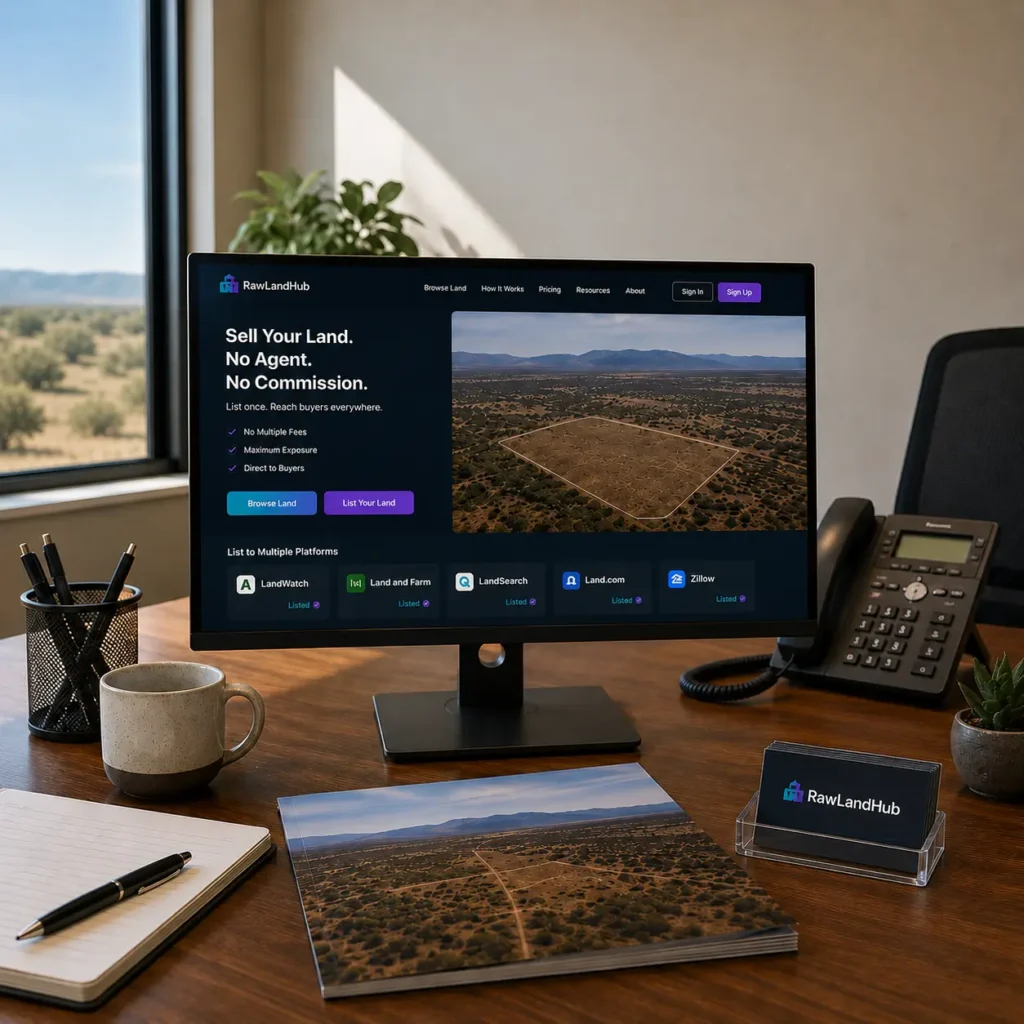
Spread your listing across the first two categories and your total cost stays flat while your reach widens. RawLandHub is built for exactly this, giving you one place to list that already reaches buyers searching specifically for land.
Why Do Multiple Listing Fees Add Up, and How Do You Avoid Them?
Listing fees add up when you confuse reach with commission, paying a percentage of your sale to each channel that touches the deal. The fix is to separate the two kinds of cost and refuse to stack the expensive one.
There are really only three cost models in land selling. Free channels like social groups and some classifieds charge nothing. Flat-fee platforms charge a set amount, often under $200 for a full year. And full-service agents charge an agent commission of 5 to 6 percent, which since the 2024 NAR settlement is openly negotiable but still the largest cost by far.
The mistake that inflates fees is treating a percentage commission as normal for reach it does not uniquely provide. A comparison of land selling platforms shows flat and free options reach the same buyers for a fraction of the cost.
Which Platforms Let You List Land for Free or a Flat Fee?
The platforms that cost little or nothing fall into four groups: dedicated land marketplaces, for-sale-by-owner sites, social and local channels, and flat-fee MLS services. Together they cover the overwhelming majority of active land buyers.
Land marketplaces are the anchor, because their entire audience is searching for parcels, and most run on a flat plan rather than a commission. The broader for sale by owner model extends that to general classifieds and FSBO sites, many of them free.
Social and local channels, including community groups and a roadside sign, cost nothing and reach nearby buyers other channels miss.
If you want the full menu of options, our roundup of websites to sell land by owner lays them out, and competitor names like LandWatch, Land.com, Zillow, and Facebook Marketplace are worth knowing even where their fees or fit do not suit land.
How Do You List on Multiple Platforms Efficiently?
You list efficiently by building one master listing first, then copying the same photos, price, and details onto every channel. Doing the work once and syndicating it keeps the process fast and, more importantly, keeps your listing consistent everywhere it appears.
Start by assembling the complete package: clear photos, a simple map, the acreage and APN, zoning, access, and a compelling description. When you write a land listing that reads well and answers the obvious questions, it performs on every platform without rework.
Then price it once from real comparable sales. A consistent fair market value across channels signals a serious seller, while a parcel priced differently on two sites tells buyers you are guessing.
One habit separates smooth multi-listing from a mess, and that is keeping a single source of truth. Track where you posted and which channel each inquiry came from, so when the price changes or the parcel sells you can update or pull every listing in minutes.
A stale price left live on one forgotten site is how good deals quietly fall apart.
What Is a Flat-Fee MLS and Is It Worth It for Land?
A flat-fee MLS is a service that lists your property on the local multiple listing system for a single upfront charge instead of a commission. It puts your parcel in front of agent-represented buyers without hiring a full-service listing agent.
The multiple listing service is the database agents use to find inventory for their clients, and a flat-fee entry buys you a spot in it for a one-time cost, often a few hundred dollars. For land, it can be worth it when a meaningful share of local buyers work through agents. It is an add-on for extra reach, not a replacement for the land-specific marketplaces where most direct buyers actually look.
The trade worth understanding is the buyer-agent side. Even with a flat-fee MLS listing you may choose to offer a commission to the buyer’s agent, typically 2 to 3 percent, to attract agent-represented buyers.
That is far less than a full listing commission, it stays optional, and it keeps you in control of your total cost.
How Do You Avoid Paying Any Commission at All?
You avoid commission entirely by selling the parcel yourself and handling the listing, inquiries, and closing directly. The percentage an agent would take is the one land-selling cost that runs into the thousands, and it is fully optional.
For-sale-by-owner activity in housing sits near an all-time low, around 5 percent of home sales per NAR, yet vacant land runs far higher because parcels are simple and buyers are direct.
That makes land the ideal asset to sell without a realtor, keeping the full commission while still reaching every buyer through flat and free channels. You take on the coordination, but on a straightforward parcel that workload is light and the savings are real.
Where Should You List Land? Cost vs. Reach at a Glance
The right mix depends on how much reach each channel adds for its cost. The table below compares the main options so you can build a stack that maximizes exposure and minimizes fees.
| Channel | Typical cost | Reach | Best for |
| Land marketplace (flat plan) | Low flat fee | High, land-specific | Your core listing |
| For-sale-by-owner site | Free to low | Medium, general | Extra reach |
| Social and local groups | Free | Local, variable | Nearby buyers |
| Flat-fee MLS | One-time flat fee | Agent-represented buyers | Casting a wider net |
| Full-service agent | 5 to 6 percent commission | Broad but not land-focused | Complex or high-value parcels |
The pattern is clear: the first three rows cost almost nothing and cover most buyers, while the last row is the only one that scales with your price. Build from the top down, and you can list your land across several channels for one small cost rather than a percentage of the sale.
What Are Common Mistakes When Multi-Listing Land?
The most common mistake is letting your listing drift out of sync across platforms, with a different price or missing details on one site.
Buyers who spot the inconsistency assume the seller is disorganized or hiding something, and the parcel loses trust everywhere. Consistency is the whole discipline of multi-listing, and it is surprisingly easy to lose once a parcel is posted in five different places.
Watch for these traps:
- Listing at different prices on different platforms, which reads as either a mistake or a bluff.
- Posting on spammy channels that flood your inbox with unqualified leads and waste your time.
- Forgetting to update or remove a listing after the parcel sells or the price changes.
- Using different photos or descriptions, so the same parcel looks like two different listings.
Keep one master listing as your source of truth and push every change from there. If you are not sure which channels are worth your time for a specific parcel, you can get in touch with our team for a quick recommendation.
How Do You Get Maximum Reach for the Lowest Cost?
You get maximum reach for the lowest cost by anchoring on a flat-fee land marketplace, layering free channels on top, and reserving any percentage commission for parcels that truly need an agent. That stack reaches nearly every buyer while keeping your total listing cost flat and predictable.
Build your master listing once, price it on real comps, and syndicate it wherever land buyers look. The savings compound, because the money you would have paid in commission or duplicate fees stays in your pocket at closing.
RawLandHub makes the core of that stack affordable with plans starting at $5, and you can create a free account with a seven-day trial and no card required.
Frequently Asked Questions
Can you list land on more than one website at once?
Yes. When you sell by owner there is no exclusivity agreement, so you can list the same parcel on a land marketplace, a for-sale-by-owner site, and local channels simultaneously. Multi-listing is standard practice and widens your buyer pool, as long as you keep the price and details identical on every platform.
Do you have to pay a fee for every platform you list land on?
No. Many channels are free, including social groups and some classifieds, and flat-fee platforms charge one set amount regardless of how many buyers see it. The only cost that scales is a percentage agent commission. Combining free and flat-fee channels lets you reach most buyers without paying a separate fee on each.
What is the cheapest way to list land on multiple sites?
The cheapest approach is to anchor on a flat-fee land marketplace, then add free for-sale-by-owner sites, community groups, and a roadside sign. This covers the large majority of land buyers for one small, predictable cost. Reserve a paid flat-fee MLS or an agent only if your market or parcel genuinely needs the extra reach.
Is a flat-fee MLS worth it for vacant land?
It can be, depending on your market. A flat-fee MLS lists your parcel where agents find inventory for their clients, for a single upfront cost rather than a commission. It is most useful when many local buyers work through agents. For most land, though, dedicated marketplaces reach the direct buyers who dominate the vacant land market.
Resources & Further Reading
- The National Association of Realtors explains how the agent commission became openly negotiable after the 2024 settlement.
- Investopedia’s overview of for sale by owner explains how selling without an agent works and its trade-offs.
- IRS Publication 561 defines fair market value, the price standard to set consistently across platforms.
- Wikipedia’s overview of the multiple listing service describes the database behind a flat-fee MLS listing.
- NAR’s report that for-sale-by-owner sales hit an all-time low provides the latest FSBO share figure.