Key Takeaways
A clear net-proceeds breakdown for landowners who want to know what actually lands in their pocket after a $50,000, $100,000, or $200,000 sale.
- The biggest deduction from a land sale is the agent commission, commonly 5 to 6 percent, which selling by owner removes entirely.
- After all costs, sellers typically net about 92 to 96 percent of the sale price, more when they skip the agent.
- On a $100,000 parcel, selling it yourself instead of paying a 6 percent commission keeps roughly $5,700 extra in your pocket.
- Closing costs, title, and transfer taxes apply whether or not you use an agent, and they vary by state.
- Capital gains tax is separate from selling costs and depends on your cost basis and how long you held the land.
Most landowners think about the sale price and forget the sale costs, then get surprised at closing when the number that hits their account is thousands lower. What you net selling land is the price minus commission, closing costs, and eventually taxes, and the gap between the sticker and the take-home is bigger than most sellers expect.
The good news is that the single largest deduction, the agent commission, is also the one you can erase completely. This guide breaks down exactly what comes out of a sale and what you keep on a $50,000, $100,000, and $200,000 parcel, so you can plan your net before you list.
Quick verdict: On land, expect to keep the large majority of your sale price, but the commission is what moves the number most. Selling with an agent nets you roughly 86 to 92 percent of the price; selling it yourself nets closer to 95 percent, because the only real difference is the commission you no longer pay. Everything else, closing costs and taxes, applies either way.
What Do You Actually Net When You Sell Land?
You net the sale price minus three things: the agent commission if you use one, the transaction closing costs, and any capital gains tax on your profit. The first is optional, the second is unavoidable but small, and the third depends entirely on your situation.
Think of it as a stack. Start with your sale price, subtract selling costs to get your net proceeds at closing, then subtract any income tax later to get your true take-home.
The proceeds figures in this guide are pre-tax, meaning what you walk away with at the closing table, because capital gains depend on your cost basis and are handled separately.
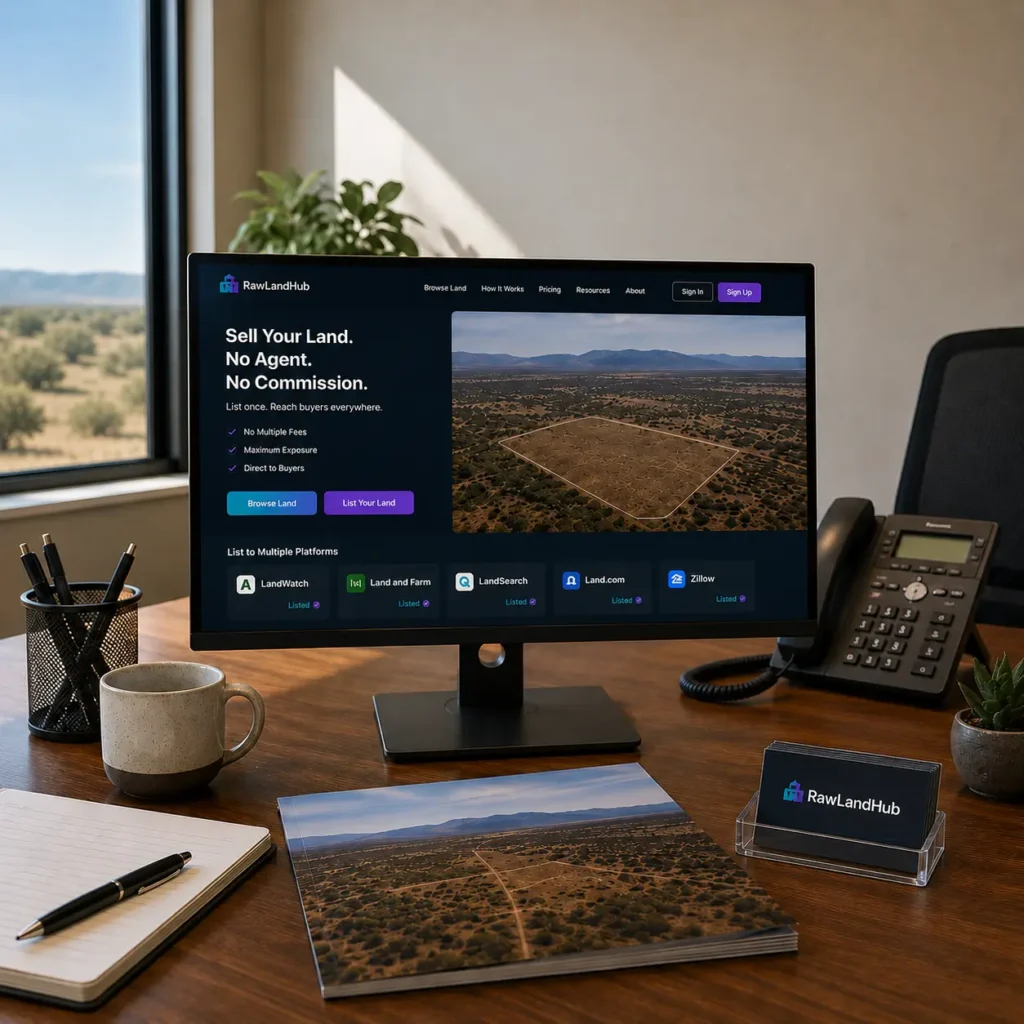
A marketplace like RawLandHub exists to shrink that middle layer, the selling costs, by cutting out the commission that dominates it.
What Costs Come Out of a Land Sale?
The costs of selling land fall into four buckets: agent commission, closing costs, transfer taxes, and capital gains tax. Only the commission is fully optional, and it is also the largest.
| Cost | Typical range | Who it hits |
| Agent commission | 5 to 6 percent of price | Only if you use an agent |
| Closing costs (title, escrow, recording) | 1 to 3 percent | Every seller |
| Transfer tax | Varies widely by state | Seller or buyer, by state |
| Prep and marketing (FSBO) | A few hundred dollars | Only if you sell yourself |
| Capital gains tax | Depends on gain and holding period | Only if you sold at a profit |
The agent commission is the swing factor, and since the 2024 NAR settlement it is openly negotiable rather than fixed. On land it commonly runs 5 to 6 percent, higher than the typical home rate because land is harder to sell.
Everything else is comparatively small and mostly unavoidable. For the full category-by-category picture of the cost to sell land, including how to trim each line, that breakdown deserves its own read. Here the focus is the bottom line at three real price points.
What You Net on a $50,000 Land Sale
On a $50,000 parcel, you net about $46,000 through an agent and about $48,800 selling it yourself, a difference of roughly $2,800. The commission alone accounts for nearly all of that gap.
| Item | With an agent | Sell it yourself |
| Sale price | $50,000 | $50,000 |
| Commission (6%) | -$3,000 | $0 |
| Closing costs (~2%) | -$1,000 | -$1,000 |
| Marketing / listing | $0 | -$200 |
| Net proceeds | ~$46,000 | ~$48,800 |
At this price, the commission is a small dollar figure but a real slice of a modest sale. Since land at this level is bought by individuals rather than developers, it is exactly the kind of parcel most owners can sell without a realtor and keep the difference.
What You Net on a $100,000 Land Sale
On a $100,000 parcel, you net about $92,000 through an agent and about $97,700 by owner, a difference of roughly $5,700. Doubling the price doubles the commission you can avoid.
| Item | With an agent | Sell it yourself |
| Sale price | $100,000 | $100,000 |
| Commission (6%) | -$6,000 | $0 |
| Closing costs (~2%) | -$2,000 | -$2,000 |
| Marketing / listing | $0 | -$300 |
| Net proceeds | ~$92,000 | ~$97,700 |
Notice that the closing costs barely move the comparison, because both paths pay them. The closing costs for title, escrow, and recording are transaction fees you owe regardless of who lists the land, so they cancel out and leave the commission as the whole story.
What You Net on a $200,000 Land Sale
On a $200,000 parcel, you net about $184,000 through an agent and about $195,600 by owner, a difference of roughly $11,600. At higher prices, the commission you avoid becomes a serious sum.
| Item | With an agent | Sell it yourself |
| Sale price | $200,000 | $200,000 |
| Commission (6%) | -$12,000 | $0 |
| Closing costs (~2%) | -$4,000 | -$4,000 |
| Marketing / listing | $0 | -$400 |
| Net proceeds | ~$184,000 | ~$195,600 |
One line here does vary more by location than the others. The transfer tax, an excise charged when ownership changes hands, ranges from nothing in some states to a meaningful figure in others, and it is often the seller’s cost. Build your own state’s rate into the closing-cost line before you count on an exact net.
Agent vs. Selling It Yourself: What You Keep at Each Price
Side by side, the pattern is consistent: selling land yourself keeps the entire commission in your pocket, and that gap grows with the price. The table below sums up all three examples.
| Sale price | Net with an agent (6%) | Net selling it yourself | Extra you keep |
| $50,000 | ~$46,000 | ~$48,800 | ~$2,800 |
| $100,000 | ~$92,000 | ~$97,700 | ~$5,700 |
| $200,000 | ~$184,000 | ~$195,600 | ~$11,600 |
The one cost both columns share is worth naming, because buyers and sellers sometimes assume it away. An owner’s title insurance policy, part of owner’s title insurance and the wider closing package, protects the deal and shows up whether or not an agent is involved. The commission is the only line that truly disappears when you sell by owner, and it is the line that matters most.
How Do Taxes Change What You Keep?
Capital gains tax is separate from your selling costs and applies only to your profit, not the whole sale price. Your profit is the sale price minus your cost basis, which is what you paid plus improvements and certain closing costs.
If you held the land more than a year, the gain is generally taxed at long-term capital gains tax rates of 0, 15, or 20 percent depending on your income, which are lower than ordinary income rates.
Keep records of your purchase price, improvements, and selling costs, because each one raises your basis and lowers the taxable gain.
This is general information, not tax advice, so confirm your own numbers with a CPA.
There is also a way to soften the tax hit through structure. If you sell with owner financing and collect payments over several years, you may be able to report the gain gradually instead of all at once, which can keep you in a lower bracket.
That is the core idea behind an installment sale, and it changes when you owe, not whether you owe.
How Do You Keep More of Your Land Sale?
You keep more by removing the commission, pricing the parcel accurately, and structuring the sale to your advantage. The first move alone is worth thousands, as the tables above show.
Selling by owner on a flat plan is the clearest win, since RawLandHub keeps listing within reach with flat monthly plans starting at $5, a few dollars against a commission that runs into the thousands.
Structuring the deal well helps too. Reporting a gain over time through an installment sale can lower the tax you owe in any single year when you carry the financing yourself.
Pricing is the quiet lever. Overprice and the land sits; underprice and you hand away more than any commission would have cost. Getting the number right is the difference between a sale that nets what you expected and one that disappoints.
Common Mistakes That Shrink Your Net
The most expensive mistakes are the ones that shrink your net without you noticing. Paying a full commission on a simple parcel an agent barely markets is the biggest, followed by underpricing because you never ran real comps and left money on the table.
Sellers also forget to budget for closing costs and transfer taxes and get surprised at the table, ignore their cost basis and overpay capital gains tax, and skip keeping receipts for improvements that would have lowered that tax.
Take the time to price your land from real comparable sales rather than guessing.
If you are unsure what you will actually net on your specific parcel, you can get in touch with our team for a second read before you list.
So What Will You Actually Net Selling Your Land?
You will net most of your sale price, and the choice that moves the number most is whether you pay a commission at all. After closing costs, expect to keep roughly 92 to 96 percent of the price, landing at the higher end when you sell it yourself and skip the 5 to 6 percent an agent would take.
Closing costs and transfer taxes are small and apply either way, while capital gains tax depends on your basis and holding period, so plan for it separately with a CPA.
The single highest-return move a land seller can make is keeping the commission, and that choice is entirely yours. RawLandHub makes it simple with plans starting at $5, and you can create a free account with a seven-day trial and no card required to see what your parcel could net.
Frequently Asked Questions
How much do you net when you sell land?
After selling costs, most land sellers net about 92 to 96 percent of the sale price. The main variable is the agent commission of 5 to 6 percent, which selling by owner eliminates. Closing costs and transfer taxes take a few more percent, and capital gains tax on your profit is separate and depends on your basis.
What are the biggest costs of selling land?
The largest cost is the agent commission, commonly 5 to 6 percent of the price, which is optional if you sell by owner. After that come closing costs like title, escrow, and recording at 1 to 3 percent, transfer taxes that vary by state, and capital gains tax on any profit. Only the commission is fully avoidable.
Do you pay capital gains tax when you sell land?
Usually yes, if you sell for more than your cost basis. Land held over a year is generally taxed at long-term capital gains rates of 0, 15, or 20 percent based on income. Your basis includes the purchase price, improvements, and some closing costs, which lower the taxable gain. Confirm your situation with a CPA.
How do you avoid paying a commission on a land sale?
Sell the parcel yourself instead of listing with an agent. A for-sale-by-owner sale on a land marketplace lets you reach buyers directly and keep the full 5 to 6 percent an agent would charge. On a $200,000 parcel that commission is around $12,000, so avoiding it is often the highest-value decision in the whole sale.
Resources & Further Reading
- The National Association of Realtors explains how the agent commission became openly negotiable after the 2024 settlement.
- The CFPB details the fees paid at closing and who typically pays each one.
- The CFPB explains owner’s title insurance, a standard closing cost on both agent and owner sales.
- Wikipedia’s overview of the transfer tax describes the excise charged when property changes hands.
- The IRS overview of capital gains explains how profit on a land sale is taxed.
- The IRS guide to installment sales covers reporting a gain gradually when you carry owner financing.