
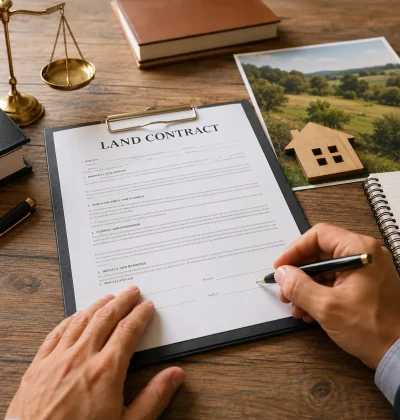
Key Takeaways
A practical guide to writing a land contract, including the clauses it must contain, a free template skeleton, and where a real estate attorney is essential.
- A land contract must be in writing and should name the parties, describe the land by its legal description, and spell out price, payments, and default terms.
- The buyer gets equitable title and possession while the seller keeps legal title until the balance is paid in full.
- The single most protective step is recording the contract; unrecorded land contracts create real risk for both sides.
- A template is a starting point, not a finished legal document, because land contract rules vary sharply by state.
- Always have a licensed real estate attorney in your state draft or review the contract before anyone signs.
Writing a land contract means putting a seller-financed land sale into a clear, enforceable document that protects both parties. Learning how to write a land contract is worth the effort because a vague or missing clause is what turns a simple owner-financed deal into a lawsuit.
This guide walks through every essential clause, gives you a free template skeleton to work from, and flags exactly where you need a real estate attorney.
One note before we start: this is general educational information, not legal advice, and land contract law varies by state, so treat everything here as a framework to bring to a licensed attorney.
Quick verdict: If your deal is simple and you are the seller, a well-drafted land contract can work beautifully to sell owner-financed land. But never sign a template as-is.
The clauses that matter most, default and title transfer, are exactly the ones that must match your state’s law, so budget for an attorney review even on a small parcel.
What Is a Land Contract, and What Should It Include?
A land contract, also called a contract for deed, is a written agreement where the seller finances the sale and the buyer pays in installments while the seller holds the deed until paid in full.
A properly written land contract gives the buyer equitable title and the right to possess and use the land, while the seller keeps legal title as security until the final payment.
At a minimum, a complete land contract should include the full legal names of both parties, an exact legal description of the property, the purchase price, the down payment, the interest rate and payment schedule, who pays taxes and insurance, what counts as default, and when and how the deed transfers. Leave any of these out and you have created ambiguity that a court may have to resolve later.
The document is doing two jobs at once. It is a sale agreement and a financing agreement bundled together, which is exactly why it needs more care than a standard purchase contract. Every term that a bank mortgage would spell out in fine print, you now have to write yourself.
What Are the Essential Clauses in a Land Contract?
The essential clauses are the parties, the property, the money, the responsibilities, default and remedies, and title transfer. Each one prevents a specific dispute, so skipping any of them is a false economy.
Start with an accurate property description. A land contract should identify the parcel by its full legal description, often written in metes and bounds or by lot and plat, not just a street address or parcel number. Boundary markers move and streets get renamed, so the legal description is what actually holds up if a boundary is ever disputed.
Next come the financial terms: purchase price, down payment, interest rate, payment amount and due date, loan term, and whether a balloon payment ends the schedule. Then the responsibilities: who pays property taxes, who insures the land, and who maintains it during the contract. Finally, and most importantly, the default and remedies clause. Some states let a seller reclaim the land through forfeiture, while others require a process closer to foreclosure, so this clause must match your state’s law exactly. Add a cure period that gives the buyer a set number of days to catch up before losing the property.
Free Land Contract Template
Below is a free land contract template skeleton you can use as a starting point. Read the warning first: this is a simplified educational framework, not a state-compliant legal document, and it must be customized and reviewed by an attorney before use.
LAND CONTRACT (CONTRACT FOR DEED)
1. PARTIES. This agreement is made on [DATE] between
[SELLER FULL NAME] (“Seller”) and [BUYER FULL NAME] (“Buyer”).
2. PROPERTY. Seller agrees to sell the real property located at
[ADDRESS], legally described as: [FULL LEGAL DESCRIPTION].
3. PURCHASE PRICE AND TERMS.
Purchase price: $[AMOUNT]
Down payment: $[AMOUNT] paid on [DATE]
Balance financed: $[AMOUNT]
Interest rate: [RATE]% per year
Payment: $[AMOUNT] per month, due on the [DAY] of each month
Term: [NUMBER] months, with a balloon payment of $[AMOUNT] due on [DATE], if any
4. TAXES, INSURANCE, MAINTENANCE. Buyer/Seller [specify] shall pay
property taxes and maintain [insurance/the land] during the term.
5. POSSESSION. Buyer may take possession on [DATE] and use the land
subject to this contract.
6. TITLE AND DEED. Seller retains legal title until the full balance is
paid. Upon final payment, Seller shall deliver a [warranty/deed type]
deed conveying title to Buyer.
7. DEFAULT AND REMEDIES. If Buyer fails to pay within [NUMBER] days of a
due date, Seller may [specify remedy per state law] after a written
cure notice and a [NUMBER]-day cure period.
8. PREPAYMENT. Buyer may prepay all or part of the balance without penalty.
9. RECORDING. This contract shall be recorded with the [COUNTY] recorder.
10. GENERAL. This is the entire agreement, governed by the laws of
[STATE]. Signed:
_______________________ _______________________
Seller / Date Buyer / Date
[Notary acknowledgment as required by state]
Treat every bracketed field as a decision to make with your attorney, not a blank to guess at. Sellers who list your land with owner financing lean on a document like this, and you can start a free trial to market the parcel once your contract is properly drafted.
How Do You Write a Land Contract Step by Step?
Writing a land contract follows a clear sequence: gather the facts, describe the property, set the terms, add protections, and record the signed document. Working in this order keeps you from missing a clause.
First, collect the exact legal names of both parties and pull the property’s legal description straight from the current deed, not from memory. Second, agree on the numbers, price, down payment, interest, payment, term, and any balloon, and write them in plain figures. Third, assign responsibility for taxes, insurance, and upkeep during the contract.
Fourth, write the protective clauses: default definition, cure period, remedy, and the title transfer terms. Fifth, sign before a notary if your state requires it, and record the contract with the county so it is part of the public record. Buyers hunting for these deals often browse land listings that already offer owner financing, which is the demand side that makes a well-written contract worth having. Skipping the recording step is where many do-it-yourself deals quietly go wrong.
Do Land Contracts Have Tax and Legal Rules to Follow?
Yes, land contracts carry specific tax and legal rules, and ignoring them is expensive. On the tax side, a land contract is usually an installment sale, so the seller reports gain as payments come in rather than all at once.
The IRS treats this under installment sale rules, where you include only the portion of each year’s payment that represents gain and report it on Form 6252. This can spread a seller’s tax over several years, but the details depend on your basis and the deal structure, so confirm the treatment with a CPA.
Legally, a land contract is a real estate contract and must be in writing to be enforceable under the statute of frauds. State law then layers on top: recording requirements, statutory default and forfeiture procedures, and interest-rate limits all vary. For raw vacant land with no dwelling, the federal seller-financing rules aimed at home loans generally do not apply, but if any residence is involved, additional federal rules can. This is general information, not legal or tax advice, so verify your state’s rules and consult a licensed real estate attorney and a CPA.
What Are Common Mistakes in Writing a Land Contract?
The most common mistake is failing to record the contract, which leaves both parties exposed if the other sells, borrows against, or disputes the property. Recording is cheap protection, and skipping it is the error that causes the most damage.
Other frequent mistakes include using a vague property description instead of the full legal description, leaving out a clear default and cure clause, and never confirming the seller actually holds clean title before signing. Many sellers also forget to decide who pays taxes and insurance, which creates conflict the moment a bill arrives. A practical safeguard is to route payments through a neutral third party using an escrow or servicing arrangement, so there is an independent record of what was paid and when.
The biggest mistake of all is treating a downloaded template as a finished contract. A template gets you 70% of the way, but the clauses that decide who keeps the land in a dispute are state-specific, and those are the ones no generic form can get right for you. If you want help reaching buyers once your contract is drafted, you can get in touch with our team.
Attorney Tips: Getting a Land Contract Right
The single best move when writing a land contract is to have a licensed real estate attorney in the property’s state draft or review it before signing. An attorney catches the state-specific default rules, recording requirements, and disclosure obligations that a template cannot.
A few tips professionals rely on. Order a title search and consider title insurance so both sides know the seller can actually convey clean title at payoff. Match the default remedy to your state, since forfeiture is fast but not available or enforceable everywhere. Put every promise in the written document, because side agreements rarely hold up. Platforms like RawLandHub help sellers reach owner-financing buyers, but the contract itself belongs in an attorney’s hands, not a marketplace’s. Spending a few hundred dollars on review is trivial next to the cost of an unenforceable contract on a five-figure parcel.
Is a Land Contract Worth It for Your Sale?
A well-written land contract is worth it when you want to sell owner-financed land and reach buyers who cannot get a bank loan, as long as the document is state-compliant and properly recorded. It is not worth the risk if you draft it carelessly or skip the attorney review to save a small fee.
Land contracts fit sellers who are comfortable carrying payments over time and want to widen their buyer pool. They are a poor fit for sellers who need all cash now, or who will not take the time to record the contract and vet the buyer first. Be honest with yourself about which group you are in before you commit.
Once your attorney-reviewed contract is ready, the next step is reaching those buyers. RawLandHub keeps that affordable with monthly plans starting at $5, and you can create a free account with a seven-day trial and no card required. The contract protects the deal, and the marketplace finds the buyer. Get both right, and owner financing becomes one of the fastest, most flexible ways to sell vacant land.
Frequently Asked Questions
Can I write my own land contract?
You can draft your own land contract, but you should not sign it without an attorney’s review. The document is legally binding and state-specific, and the clauses that matter most, default and title transfer, are exactly where do-it-yourself contracts fail. Use a template to organize the deal, then have a licensed real estate attorney finalize it before anyone signs.
Does a land contract need to be notarized and recorded?
In most states, yes for recording, and often yes for notarization. Recording the land contract with the county protects both parties by putting the agreement in the public record. Notarization requirements vary by state but are commonly needed to record the document. Skipping recording is one of the most damaging mistakes in owner-financed land deals, so confirm your county’s rules.
What is the difference between a land contract and a deed?
A land contract is the financing agreement; the deed is the document that actually transfers ownership. Under a land contract, the seller keeps the deed and legal title until the buyer finishes paying, while the buyer holds equitable title and possession. When the balance is paid in full, the seller delivers the deed, and legal ownership transfers to the buyer.
Is a land contract a good idea for selling vacant land?
It can be, especially for sellers who want to reach buyers who cannot qualify for a bank loan. A land contract can sell hard-to-finance parcels faster and spread the seller’s tax over years. The risks come from weak drafting and buyer default, which is why a state-compliant, attorney-reviewed contract and proper recording are essential.
How detailed does the property description need to be?
Very detailed. A land contract should use the full legal description from the current deed, such as a metes and bounds or lot-and-plat description, not just a street address or parcel ID. An accurate legal description is what holds up if a boundary is ever disputed, since addresses and markers can change while the recorded legal description remains fixed.
Resources & Further Reading
- Wikipedia’s overview of the land contract explains equitable versus legal title, installment payments, and default.
- The IRS Topic 705 page on installment sales covers how a seller reports gain as payments are received.
- Wikipedia’s article on the real estate contract explains why real estate agreements must be in writing to be enforceable.
- Wikipedia’s guide to metes and bounds shows how a legal description defines a parcel’s boundaries.
- Wikipedia’s overview of foreclosure helps explain how default remedies differ from simple forfeiture.
- Wikipedia’s entry on escrow describes using a neutral third party to hold funds and records.