Key Takeaways
A practical guide to timber land value for landowners: how to estimate what your standing trees are worth, what drives the number, and when to call a forester.
- Timber is a separate asset that sits on top of your bare land value, so a wooded parcel is often worth far more than the dirt alone.
- You calculate standing timber value as volume times stumpage price, where a timber cruise measures the volume by species and product.
- Species, tree size, quality, stocking, access, and distance to the mill drive the number, and stumpage prices swing widely by region and quarter.
- Never trust a single online per-acre figure, because the same volume can be worth $60,000 or $120,000 depending on market and species.
- For any real timber sale, a consulting forester’s cruise usually pays for itself by pricing the timber accurately and running a competitive sale.
If you own wooded land, the trees on it may be worth more than the ground underneath them, and most owners have no idea what that number is. Timber land value combines two separate things: the value of the bare land and the value of the standing timber growing on it.
Calculating what the trees are worth comes down to measuring how much timber you have and multiplying it by what buyers currently pay.
This guide walks through the real method foresters use, the factors that move the number, a worked example, and when you should stop estimating and hire a professional.
Quick verdict: You can get a rough sense of your timber land value yourself by estimating volume and applying local stumpage prices, which is fine for a ballpark or a purchase decision.
But for an actual timber sale, hire a consulting forester to run a cruise and market the sale, because accurate volume and competitive bidding almost always net you more than the fee costs. Treat any online per-acre timber figure as a loose starting point, never a real valuation.
What is timber land value, and why is it separate from land value?
Timber land value is the combined worth of the bare land plus the standing timber growing on it, and the two are valued separately because they sell separately. The dirt has a value based on location, access, and use, while the trees have their own value based on volume, species, and market. A buyer can purchase the land and the timber together, or you can sell the timber now and keep the land.
The value of the standing trees is called stumpage, the price a buyer pays for timber as it stands, before it is cut. That distinction matters because timber is a harvestable, renewable asset. On many rural parcels, a mature stand of timber represents a large share of total value, sometimes exceeding the bare land itself. Knowing both numbers separately lets you decide whether to sell the timber, the land, or both, and it keeps you from underpricing a wooded parcel by ignoring the trees.
How do you calculate the value of standing timber?
You calculate standing timber value by measuring the timber volume by product and multiplying each product by its current stumpage price, then adding the results. The formula is simple; the accuracy lives in the measurement. In plain terms, timber value equals volume times price, summed across every product on the tract.
Timber is sold in products, and each has its own unit and price. Sawtimber, the large trees milled into lumber, is measured in board feet, usually reported in thousands called MBF, and a single board foot is a piece 12 inches square and 1 inch thick. Smaller trees sold as pulpwood are measured in cords or tons. You multiply each product’s volume by its stumpage price per unit, so a stand might earn a sawtimber price per MBF plus a separate pulpwood price per ton. Getting the volume right is the hard part, which is exactly what a timber cruise is for.
What is a timber cruise, and how does it measure volume?
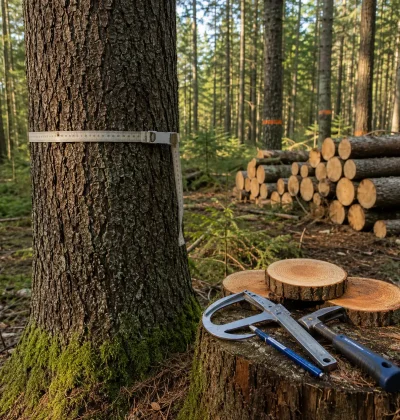
A timber cruise is a systematic sampling of your woods that estimates how much timber you have by species and product. A forester walks the tract, measures trees on a set of sample plots, and scales those samples up to the whole property. It is the timber-world version of a forest inventory, and it is the foundation of any credible timber valuation.
On each plot, the forester records the species, the tree height, and the trunk diameter, measured as diameter at breast height, taken at 4.5 feet above the ground. Those measurements feed volume tables that convert standing trees into board feet and tons. The result is a report telling you how many MBF of sawtimber and how many tons or cords of pulpwood you own, broken out by species. Without a cruise, any timber value figure is a guess, because two tracts of the same acreage can hold wildly different volumes depending on age, stocking, and past cutting.
What determines how much your timber is worth?
Timber value is driven by species, tree size and quality, volume per acre, access, and distance to the mill, on top of the current market. These factors explain why two identical-sized tracts can be worth very different amounts. The table below breaks down what pushes timber value up or down.
| Factor | Raises timber value | Lowers timber value |
| Species | High-demand hardwoods, veneer-grade oak or walnut, quality pine | Low-value or cull species |
| Tree size | Large-diameter sawtimber and veneer trees | Small-diameter pulpwood only |
| Quality and grade | Straight, clear, defect-free logs | Crooked, knotty, damaged stems |
| Stocking per acre | Dense, well-stocked stands | Thin, understocked woods |
| Access | Good roads, gentle terrain, easy hauling | Landlocked, steep, or wet ground |
| Distance to mill | Close to sawmills and pulp mills | Long, costly haul distance |
Size and quality matter enormously, since a large, straight, veneer-grade tree can be worth many times a small pulpwood stem of the same species. Trees are measured by their diameter partly for this reason, because diameter drives both volume and grade. Access and haul distance also cut directly into what a buyer will pay, since logging costs come out of your stumpage. If you want help weighing the land side against the timber, you can get in touch with our team.
Worked example: estimating timber value on a 40-acre tract
Here is an illustrative example so the method feels concrete. The prices below are illustrative only, because real stumpage prices vary widely by region, species, and quarter, but the arithmetic shows exactly how the calculation works.
Say a cruise finds a 40-acre pine tract holds 6,000 board feet of sawtimber per acre and 12 tons of pulpwood per acre. That totals 240,000 board feet, or 240 MBF, of sawtimber and 480 tons of pulpwood across the tract. Apply an illustrative stumpage price of $350 per MBF for the sawtimber and $10 per ton for the pulpwood:
- Sawtimber: 240 MBF times $350 equals $84,000
- Pulpwood: 480 tons times $10 equals $4,800
- Total illustrative timber value: about $88,800, or roughly $2,220 per acre
Now see how much the market moves the number. That same 240 MBF of sawtimber is worth $60,000 at $250 per MBF, $84,000 at $350, and $120,000 at $500. Nothing about the trees changed, only the price. This is precisely why a single online per-acre figure is meaningless and why current local stumpage prices matter so much.
Why do stumpage prices vary so much?
Stumpage prices vary because they depend on species, product, local mill demand, and the moment you sell, none of which is constant. There is no single national timber price, and a number that is accurate in one county and quarter can be badly wrong in another. Anyone quoting you a flat per-acre timber value without a cruise and local prices is guessing.
Several forces move the market. Mill demand rises and falls with housing and paper markets, species prices shift as buyers compete, and a region with many nearby mills pays more than a remote one because hauling is cheaper. Current stumpage prices are tracked by state forestry agencies and university extension services, and the USDA Forest Service publishes broad timber market data. Before you value or sell timber, get price reports for your specific state, species, and product, since that local number is the one that determines your check.
Should you estimate it yourself or hire a consulting forester?
Estimate it yourself for a rough ballpark, but hire a consulting forester for any real timber sale, because the accuracy and the competitive sale process almost always net you more than the fee. A landowner can pace off rough acreage and apply local prices for a loose figure, which is useful when deciding whether to buy a wooded parcel or how much timber might be there. That is where DIY ends.
A consulting forester does three things you cannot easily do alone: runs an accurate cruise, prices the timber against current markets, and puts the sale out for competitive bids among multiple buyers. That last step often raises the price by more than the forester’s fee, which is typically a percentage of the sale. You can find a credentialed professional through the Society of American Foresters.
If your goal is to sell the timber and then move the land, a forester also helps you understand the value picture before you sell your land, so you price the parcel with the timber accounted for.
How does timber value fit into your total land value?
Timber value is one component of your total land value, added on top of the bare land, so a wooded parcel should be priced for both. When you value or sell a timbered property, the trees and the ground each contribute, and ignoring either one leaves money on the table.
A buyer of raw wooded land is really paying for the dirt plus the standing timber plus the future growth.
That is why an accurate land number and an accurate timber number belong together. To gauge the bare land side quickly, an instant land estimate reflects location, access, and use, which you then add to a cruise-based timber figure for total value.
RawLandHub is an AI land marketplace built for vacant and rural land, where buyers actively look for parcels like yours, timber and all. Pricing the land accurately and disclosing the timber volume gives serious buyers the full picture and supports a stronger asking price.
What mistakes should you avoid when valuing timber?
The most common mistakes are trusting online per-acre averages, skipping the cruise, and selling timber without competitive bids. Online figures ignore your species, stocking, access, and local market, so they can be off by more than double in either direction.
Selling on the first offer, without a cruise or a competitive sale, is how landowners leave thousands of dollars on the stump.
Other frequent errors include forgetting that logging cost and haul distance reduce your stumpage, overvaluing small pulpwood-only stands, and cutting immature timber that would be worth far more in a few years. Comparing your parcel against active land listings helps you sanity-check the land side, but the timber side needs real measurement. Get a cruise, get local prices, and get more than one buyer to the table, and you will capture what your trees are actually worth.
The bottom line on timber land value
Timber land value is the bare land plus the standing timber, and the trees can be the larger share on a mature wooded tract. The method is straightforward, volume times stumpage price, but the accuracy depends on a real cruise and current local prices, not an online average. Estimate for a ballpark, and bring in a consulting forester for any actual sale.
When you are ready to value or sell the land itself, you can list your parcel with the timber accounted for, and the listing plans start at a few dollars a month with no commission, so you keep the full value of both your land and your trees.
Frequently asked questions
How do I find out what my timber is worth?
Have a consulting forester run a timber cruise to measure your volume by species and product, then apply current local stumpage prices to each product. Volume times price, summed across sawtimber and pulpwood, gives your standing timber value. For a rough ballpark you can estimate volume and use state price reports, but a cruise is the only reliable way before selling.
How much is an acre of timber worth?
It varies enormously, from a few hundred dollars to several thousand per acre, depending on species, tree size, stocking, access, and current stumpage prices. There is no reliable single figure, since the same volume can be worth double in one market versus another. Only a cruise plus local prices for your species and products gives a real per-acre number for your specific land.
What is stumpage price?
Stumpage price is the amount a buyer pays for standing timber as it stands, before it is cut and hauled. It is quoted per unit, such as dollars per thousand board feet for sawtimber or per ton for pulpwood. Stumpage is what lands in your pocket, and it already accounts for the buyer’s logging and hauling costs, which is why access and haul distance affect it.
Do I need a forester to sell my timber?
You do not legally need one, but hiring a consulting forester for a timber sale usually pays for itself. They cruise the timber accurately, price it to the current market, and run a competitive sale among multiple buyers, which often raises the price by more than their fee. Selling on a single unsolicited offer without a cruise is how owners get underpaid.
Is timber value included in land value?
Timber value is a separate asset added on top of bare land value, though a buyer may purchase both together. When valuing or selling wooded land, price the dirt and the standing timber separately, then combine them. Ignoring the timber underprices the parcel, and ignoring the land underprices the whole. A full valuation accounts for both plus future timber growth.
Resources & Further Reading
- This overview of stumpage explains the value of standing timber before it is harvested.
- A board foot is the standard unit used to measure and price sawtimber volume.
- The concept of a forest inventory describes how a timber cruise samples and scales up your volume.
- Trees are measured by diameter at breast height, which drives both volume and grade.
- The USDA Forest Service provides forestry data and timber market information for landowners.
- The Society of American Foresters helps you find a credentialed consulting forester for a cruise or sale.