Key Takeaways
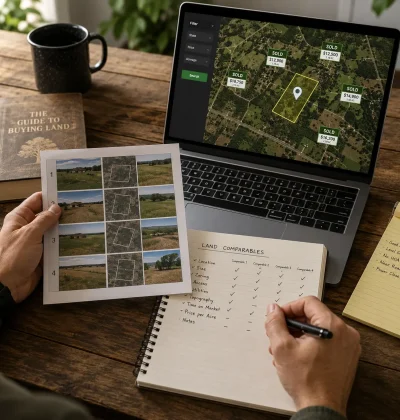
You can run the same comparable sales analysis a broker or appraiser would, using public sold data and a simple adjustment grid, no license required.
- A land CMA works in five steps: find recent sold comps, select the best three to five, convert to price per acre, adjust for differences, and reconcile to a value.
- Always use SOLD prices, never active listing prices, because listings show what sellers hope for, not what buyers actually paid.
- Convert every comp to price per acre, but remember smaller parcels sell for more per acre, so adjust for size differences.
- The core skill is adjustment: if a comp is worse than your parcel in a feature, adjust it up; if it is better, adjust it down.
- Land comps are sparser and messier than home comps, so widen your search area and time window and expect a value range, not a single exact number.
Figuring out what your land is worth does not require paying for an appraisal or handing a broker your listing. A comparable sales analysis, often called a CMA, is the same method professionals use, and you can do it yourself with public records and a spreadsheet.
This guide shows you exactly how to do a land comparable sales analysis without a realtor, from finding real sold comps to building an adjustment grid and reconciling to a defensible value. Every step includes what land buyers and appraisers actually look at, plus a worked example you can copy.
Quick verdict: Do your own land CMA if you want a data-backed price without paying for an appraisal, and you are willing to dig for sold comps and make honest adjustments. It works best when a few similar parcels have sold nearby recently.
If your land is truly unique or almost nothing has sold near it, lean on an instant AI estimate as a cross-check or order a formal appraisal for high-stakes situations.
What is a land comparable sales analysis (CMA)?
A land comparable sales analysis is a method of estimating a parcel’s value by comparing it to similar parcels that recently sold. It is the do-it-yourself version of the sales comparison approach that appraisers use and the CMA that land brokers prepare, and it rests on a simple idea: your land is worth roughly what comparable land nearby has been selling for, once you account for the differences.
There are three ways to get this number, and they differ in cost and formality. A licensed appraiser produces a formal, defensible valuation for a fee, a land broker prepares a CMA to win your listing, and you can run your own analysis for free.
For most by-owner sellers, a careful self-run CMA is enough to set a confident asking price, and it teaches you exactly how buyers will judge your number. This guide focuses on that DIY path, using the same logic a professional real estate appraisal would apply.
Why are land comps harder than home comps?
Land comps are harder because land sells far less often, every parcel is different, and there is no square-footage shortcut. A home appraiser can usually find several nearly identical houses sold within a mile in the last few months. For land, you may have to search a wider area and a longer time window just to find three or four rough matches, and even then they differ in access, utilities, terrain, and use.
The other complication is that land is priced per acre, and price per acre is not linear. A 2-acre lot might sell for $8,000 per acre while a 40-acre tract nearby sells for $3,000 per acre, even though they are the same type of land, simply because smaller parcels command a premium per acre. That means you cannot just average price per acre across different-sized comps without adjusting for size. Accept up front that a land CMA produces a reasonable range, not a single perfect number, and you will use it correctly.
Step 1: Find recent sold land sales, not listings
Start by finding parcels that actually sold, because sold prices are the only reliable evidence of value. Active listing prices tell you what sellers are asking, which is often optimistic and sometimes wildly so. You want closed, recorded sales from roughly the last 6 to 12 months, extending to 18 months if sales are scarce.
Public records are your best free source. County recorder and appraisal district or assessor websites publish recorded deeds and, in many states, sale prices. Plat maps and GIS portals help you see parcel size and location. You can also study recently sold and active recent land listings to understand asking prices and how quickly parcels move, then confirm actual sold figures through public records. Talking to a local title company or county office can fill gaps. Cast a wide enough net to gather at least five to eight candidate sales before you narrow down.
Step 2: Select your three to five best comparables
Narrow your candidates to the three to five that most resemble your parcel, because quality of comps matters far more than quantity. The closer each comp is to your land in the ways buyers care about, the fewer adjustments you have to make and the more accurate your result.
Rank candidates on the factors that drive land value: proximity to your parcel, similar acreage, the same or similar zoning and permitted use, comparable legal access, similar utilities, and a recent sale date.
A parcel of the same size, with the same access and utilities, sold three months ago a mile away is gold. One that is triple the size, landlocked, and sold two years ago in the next county is nearly useless.
Also match the intended use, since a recreational tract and a development lot follow different highest and best use logic even at the same size. Pick the closest matches and set the rest aside.
Step 3: Convert every comparable to price per acre
Put all your comps on the same footing by dividing each sale price by its acreage to get price per acre. This is the standard unit for comparing land, and it lets you line up parcels of different sizes. A 10-acre parcel that sold for $52,000 is $5,200 per acre; an 8-acre parcel that sold for $48,000 is $6,000 per acre.
But do not stop there, because size itself changes price per acre. As a rule, smaller parcels sell for more per acre and larger parcels for less, so a raw price-per-acre comparison between a 5-acre and a 40-acre comp is misleading. Note each comp’s size next to its price per acre, and plan to adjust for the size gap in the next step. Getting everything into price per acre is the setup; the adjustments are where the real accuracy comes from.
Step 4: Adjust each comparable for differences
Adjust each comp so it matches your parcel, following one rule: if a comp is inferior to your land in some feature, adjust its price up; if it is superior, adjust it down. You are answering the question, what would this comp have sold for if it were just like my parcel? Make adjustments in dollars per acre for each meaningful difference: size, access, utilities, terrain, water, zoning, and date of sale.
Here is a worked example. Your subject parcel is 10 acres with legal road access, power at the road, and gently rolling, buildable ground.
| Feature | Comp 1 | Comp 2 | Comp 3 |
| Sold price per acre | $5,200 | $4,500 | $6,000 |
| Size vs 10 acres | 10 ac, $0 | 12 ac, +$200 | 8 ac, -$700 |
| Power at road | Yes, $0 | No, +$500 | Yes, $0 |
| Terrain | Good, $0 | Good, $0 | Steep, +$300 |
| Adjusted price per acre | $5,200 | $5,200 | $5,600 |
Comp 2 started lower because it lacked power and was larger, so it adjusts up to match your parcel. Comp 3 started higher because it was smaller, but it had steep terrain, so it nets out slightly above. Keep adjustments honest and modest, and base them on real cost differences a buyer would recognize, such as the price of running power or the value that legal access adds.
Step 5: Reconcile your comps to a final value
Reconcile by weighting your most similar comps most heavily, then settling on a value range rather than a single figure. In the example above, the three adjusted figures are $5,200, $5,200, and $5,600 per acre. Because the first comp needed no adjustments, it deserves the most weight, so a reasonable conclusion is roughly $5,200 to $5,300 per acre.
Apply that to your acreage: 10 acres at $5,200 to $5,300 per acre gives a value of about $52,000 to $53,000. That range is your data-backed asking guide. Price at the top of it if you can wait for the right buyer, or toward the middle for a faster sale.
To sanity-check your manual number against a model built on the same comparable data, an instant land estimate is a fast second opinion, and the concept behind it, an automated valuation model, does exactly what you just did by hand, only across more data.
Common mistakes in a do-it-yourself land CMA
The biggest mistakes are using listing prices instead of sold prices, skipping adjustments, and choosing convenient comps over comparable ones. Listing prices reflect hope, not value, and building your number on them almost guarantees overpricing. Averaging raw price per acre without adjusting for size, access, and utilities produces a figure that is precise but wrong.
Other frequent errors include using comps that are too old or too far away, ignoring the size effect on price per acre, and letting optimism inflate your adjustments. Be your own skeptic: if you would not accept an adjustment from a buyer, do not make it in your own favor.
When comps are genuinely scarce, widen your radius and time window, note the added uncertainty, and treat your result as a broader range, or you can get in touch with our team. A CMA built on honest comps and honest adjustments will hold up when a buyer challenges your price.
When should you use AI or a professional appraiser instead?
Use a self-run CMA for most by-owner sales, an AI estimate for a fast cross-check, and a professional appraiser when the stakes or the parcel demand it. If several similar parcels have sold nearby, your own analysis will land close, and an AI valuation confirms it in seconds. The two together give most sellers all the confidence they need to price and list.
Reach for a licensed appraiser when a lender, court, or the IRS requires a formal valuation, when the parcel is unique enough that comps are thin, or when a large sum rides on the number. An appraisal costs money and takes time, but it carries formal weight your own CMA does not. For everyday pricing, though, the DIY method plus a quick AI check is efficient and accurate, which is why so many sellers now sell their land confidently without ever paying for one. RawLandHub is an AI land marketplace that pairs that pricing data with the buyers who act on it.
Turn your CMA into a listing
Once your comparable sales analysis gives you a confident number, the next step is getting it in front of buyers. A researched price backed by real sold comps is exactly what serious buyers respect, and it defends your asking number when offers come in, so you can create a free account and put your number to work.
When you are ready, you can list your parcel with your researched price and reach land buyers directly, and the listing plans start at a few dollars a month with no commission taken from your sale.
Frequently asked questions
How do I find comparable sales for land for free?
Use public records: county recorder or clerk sites list recorded deeds, and county appraisal district or assessor portals often show parcel sizes and, in many states, sale prices. GIS and plat maps show location and acreage. Cross-reference with recently sold parcels and confirm figures through a local title company. Aim for closed sales within the last 6 to 12 months near your parcel.
How many comps do I need for a land CMA?
Three to five good comparables are enough for a solid land CMA, and quality matters far more than quantity. One nearly identical parcel that sold recently nearby is worth more than ten distant, dissimilar sales. If you can only find one or two close matches, widen your search area and time window to gather more, and treat your final value as a broader range to reflect the added uncertainty.
Should I use price per acre or total price for land comps?
Use price per acre to compare parcels of different sizes, but adjust for the size effect. Smaller parcels sell for more per acre and larger ones for less, so a raw price-per-acre average across very different sizes is misleading. Convert each comp to price per acre, adjust for the size gap against your parcel, then apply the reconciled figure to your acreage for a total value.
Can I do a land CMA without a realtor or appraiser?
Yes. A comparable sales analysis requires no license, only public sold data and honest adjustments. Many by-owner sellers run their own CMA to set an asking price and use an instant AI estimate to cross-check it. Order a formal appraisal only when a lender, court, or tax authority requires one, or when the parcel is unusual enough that reliable comps are hard to find.
How is a land CMA different from a home CMA?
A land CMA relies on price per acre and must account for size, access, utilities, terrain, and zoning, while a home CMA leans on square footage, bedrooms, and condition. Land sells far less often, so comps are sparser and you search wider areas and longer time windows. Land also has no building to inspect, so every clue comes from the parcel’s characteristics and its sold comparables.
Resources & Further Reading
- The sales comparison approach explains the professional method a comparable sales analysis is built on.
- This overview of real estate appraisal shows how appraisers reach and defend a value.
- The concept of highest and best use helps you match comps by intended use, not just size.
- An automated valuation model is the technology that runs this same comparison automatically across large datasets.
- The Appraisal Institute publishes professional valuation standards and education for how property value is measured.
- The USDA reports national land values per acre by state and land type, a useful benchmark for your comps.