Key Takeaways
The states where you can genuinely buy rural land under $1,000 per acre, backed by real USDA data, plus the pitfalls that make cheap land risky.
- New Mexico is the cheapest state for rural land, with USDA pastureland at $630 per acre in 2025.
- Wyoming, Nevada, Montana, and Arizona also have pastureland under $1,000 per acre.
- These states are cheap because of arid rangeland, low population, and large amounts of remote land.
- Cheap land is often cheap for a reason, so no legal access, no water, and no utilities are the top risks.
- You can find sub-$1,000-per-acre parcels in many states, not just these, if you go remote and do your due diligence.
Cheap rural land is real, but the internet is full of vague lists that never show you a number. This guide uses actual 2025 USDA land value data to rank the states where you can buy rural land under $1,000 per acre, explains why they are so cheap, and warns you about the traps that make a bargain parcel worthless. If you want to own acreage without spending a fortune, start here and buy with your eyes open.
Quick verdict: The cheapest rural land in America is in the arid West, led by New Mexico at $630 per acre for pastureland. Wyoming, Nevada, Montana, and Arizona round out the sub-$1,000 states. The land is cheap for real reasons, though, so verify access, water, and utilities before you buy, because a $500-per-acre parcel you cannot reach or build on is not a deal.
Are There Really States With Land Under $1,000 Per Acre?
Yes, and the data proves it. Government figures cut through the hype and show exactly where rural land is genuinely cheap. The numbers are lower than most people expect.
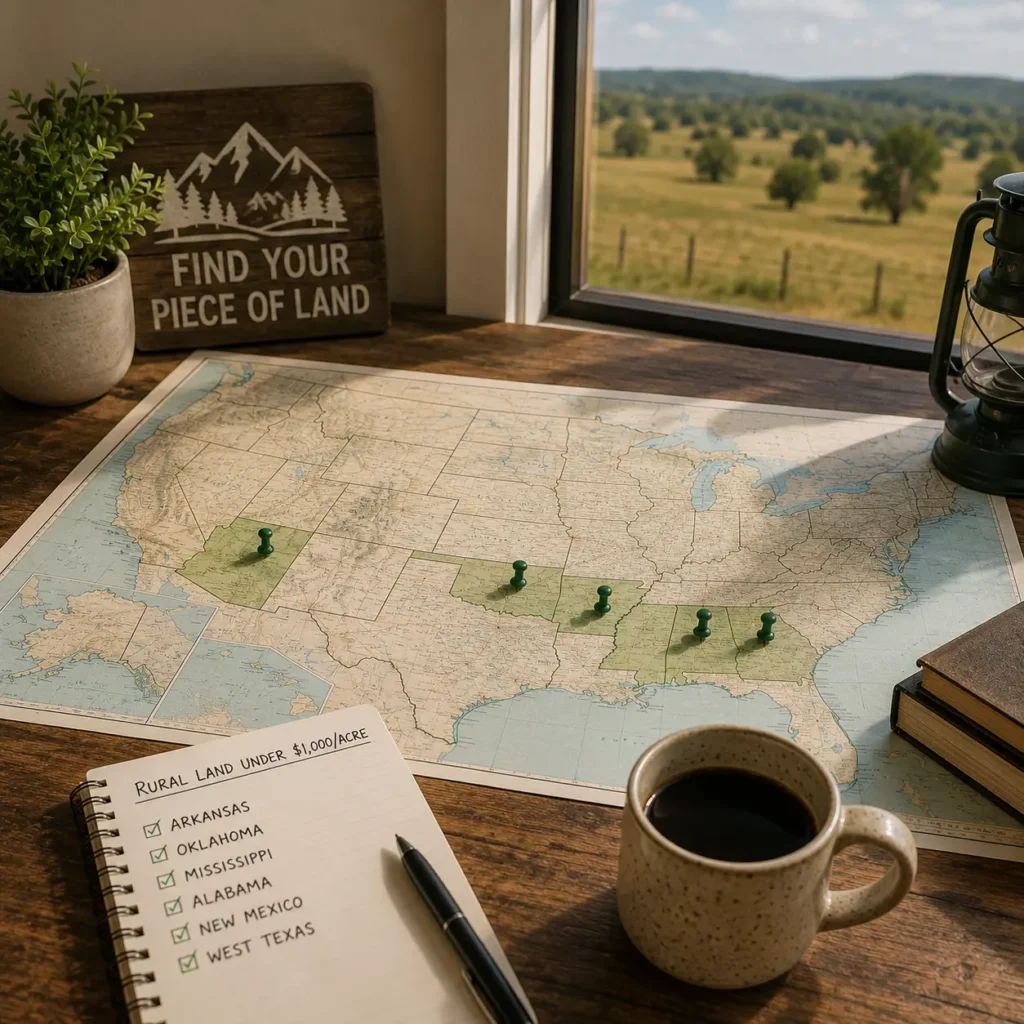
According to the USDA, the 2025 national average was $4,350 per acre for farm real estate and $1,920 per acre for pastureland. But the 2025 USDA Land Values report shows pastureland ranging all the way down to $630 per acre in New Mexico. Pastureland, which is grazing and rangeland, is the best proxy for raw rural land, since farm real estate figures are inflated by expensive irrigated cropland.
The 7 Cheapest States to Buy Rural Land
Here are the states where rural land is genuinely cheapest, ranked by 2025 USDA pastureland value per acre. The first five are all under $1,000.
| State | Pastureland ($/acre, 2025) | Why It’s Cheap | Watch Out For |
| New Mexico | $630 | Vast arid rangeland, low demand | Water rights, no utilities |
| Wyoming | $755 | Rangeland, smallest population | Remote, harsh winters, access |
| Nevada | $850 | Desert, huge public land share | Water, off-grid only |
| Montana | $920 | Rangeland, remote acreage | Distance, winters, access |
| Arizona | $950 | Desert parcels, off-grid country | Water, heat, POA dues |
| Oregon | $1,080 | Eastern high desert | Remote, wildfire, water |
| Colorado | $1,150 | Eastern plains, San Luis Valley | Water rights, access |
New Mexico, Wyoming, Nevada, Montana, and Arizona all come in under $1,000 per acre for pastureland, and remote parcels in any of them routinely sell for far less. You can browse listings across these states on a vacant land marketplace to see real asking prices.
Why Is Land So Cheap in These States?
The cheapest states share a common profile, and understanding it tells you what you are actually buying. Cheap land is a function of supply, demand, and usability.
These states have enormous amounts of arid rangeland with low agricultural productivity, small populations, and limited development pressure, which keeps demand and prices down. Much of the West is also federally owned, and the Bureau of Land Management administers vast public acreage, so private rural land competes in a market with abundant supply. Low rainfall, remoteness, and a lack of utilities all push per-acre prices toward the bottom of the national range.
The Catch: Why Cheap Land Is Often Cheap for a Reason
This is the part the bargain listings never mention. A low price per acre frequently reflects a real limitation, and knowing which one saves you from a bad buy. Cheap is not the same as valuable.
The most common reasons a parcel is priced low are no legal road access, meaning the land is landlocked without a recorded easement, no water or water rights, and no utilities, so it is off-grid only. Others include flood or wetland status, which you can check on the FEMA Flood Map Service Center, unbuildable zoning, or property-owner-association dues that add ongoing cost. A cheap parcel with none of these problems is a genuine deal, and one with several is a money pit.
How to Find Cheap Land That Is Actually Worth Buying
The goal is not the lowest price, it is the best value, meaning cheap land you can actually use. A little filtering separates the deals from the traps. Search smart, then verify.
Search a land-focused platform, filter by your target states and budget, and prioritize parcels with legal access and a usable profile. An AI-powered land marketplace lets you filter by state, price, and features, and you can create a free account to set alerts and message sellers directly. Always confirm access, water, utilities, zoning, and flood status before you buy, since due diligence is what turns a cheap parcel into a smart purchase.
Is Cheap Rural Land a Good Investment?
Cheap land can be a solid long-term hold or a money pit, and the difference is fundamentals. Be honest about why you are buying. Price alone is never the answer.
Buy cheap rural land if you want off-grid acreage, a recreational parcel, a homestead site, or a long-term hold in a growing area, and the parcel has real access and usability. Investors who buy and resell cheap land can do well, and many are also sellers, so if you plan to flip, it helps to know how to list your land and what the seller plans cost. Just never buy purely on a low per-acre number without checking what you can actually do with it.
Who Should Buy Cheap Rural Land?
Cheap rural land fits specific goals, not everyone, so match it to your plans. The right buyer sees past the price to the use.
It suits homesteaders, off-grid buyers, hunters, recreational owners, and patient long-term investors who accept remoteness in exchange for low cost. It is a poor fit if you need utilities, easy access, or a quick resale, or if you will not do due diligence. When you are ready to search real parcels across the cheapest states and buy with confidence, you can start free today.
Frequently Asked Questions
What is the cheapest state to buy rural land?
New Mexico. According to 2025 USDA data, its pastureland averages $630 per acre and its overall farm real estate $725 per acre, the lowest in the nation. Wyoming, Nevada, Montana, and Arizona also have pastureland under $1,000 per acre. Remote parcels in any of these states routinely sell for even less.
Can you really buy land for under $1,000 an acre?
Yes. USDA data shows pastureland under $1,000 per acre in New Mexico, Wyoming, Nevada, Montana, and Arizona, and remote parcels in many other states sell below that too. The catch is that cheap land often lacks legal access, water, or utilities, so a low price frequently reflects a real limitation you must verify.
Why is rural land so cheap in the western states?
The cheapest western states have vast arid rangeland with low agricultural value, small populations, little development pressure, and large amounts of federal public land, all of which keep prices down. Low rainfall, remoteness, and a lack of utilities further reduce per-acre value. The land is cheap because demand and usability are limited, not because it is a hidden secret.
Is cheap rural land a good investment?
It can be, if the parcel has real access and usability and you buy for the right goal, like off-grid living, recreation, or a long-term hold. It is a poor investment if the land is landlocked, has no water, or cannot be built on. Never buy purely on a low per-acre price without confirming what you can actually do with it.
What should I check before buying cheap land?
Confirm legal road access or a recorded easement, water availability or rights, utility access, zoning and allowed use, and flood or wetland status using the FEMA flood map. Also check property taxes and any property-owner-association dues. Cheap parcels often carry one of these limitations, and verifying them is how you avoid buying a worthless bargain.
Resources & Further Reading
- The USDA Economic Research Service tracks average farmland values per acre nationally and by region.
- The 2025 USDA Land Values report gives per-acre farmland and pastureland values by state.
- This overview of rangeland explains the arid grazing land that makes western states cheap.
- The Bureau of Land Management administers the federal public land that shapes western land markets.
- The FEMA Flood Map Service Center lets you check a parcel’s flood zone before buying.
- This explainer on easements covers the legal access that cheap landlocked parcels often lack.